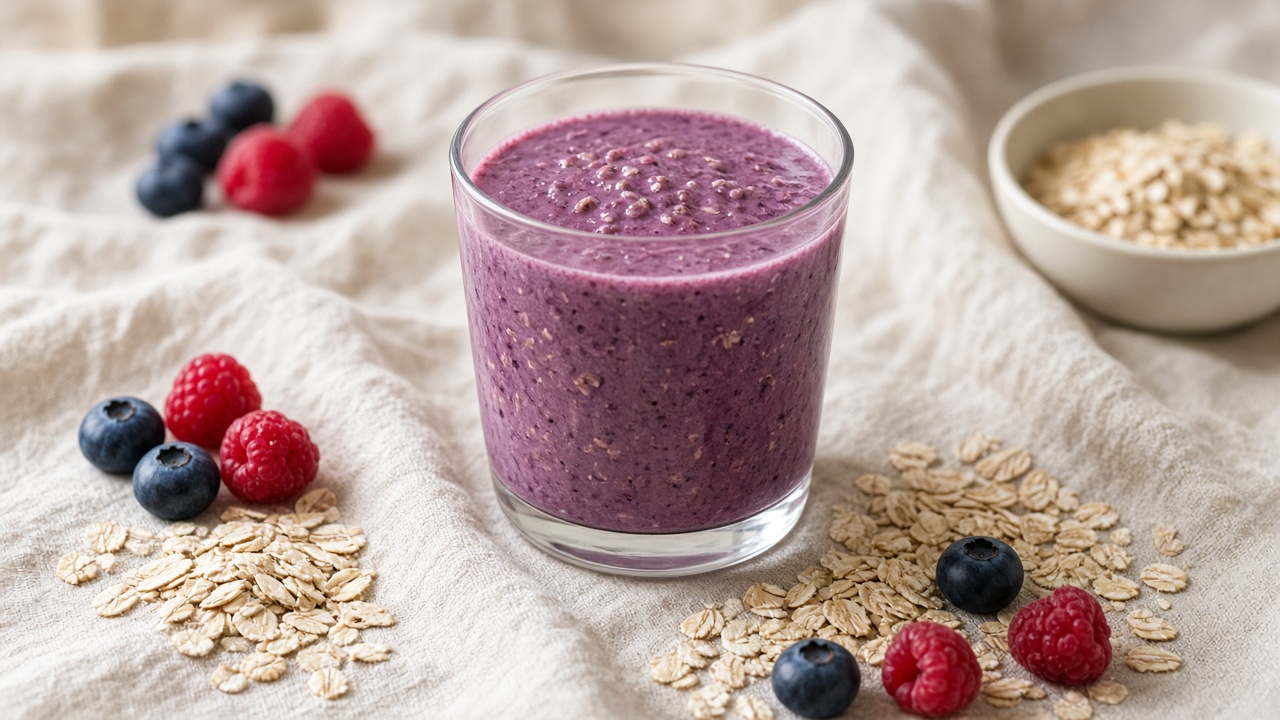
Gluten-Free Oat Berry
Oats are not wheat, rye, or barley. A gluten-free claim on the package is what 21 CFR 101.91 defines, and the berries and milk still need weighing.
Ingredients on the card
- 1/3 cup Certified gluten-free rolled oats
- 1 cup Mixed berries
- 1 cup Unsweetened almond milk
- 1 tsp Maple syrup (optional)
Blend order
- Blend oats with almond milk first so they grind smoothly.
- Add berries and maple syrup if using.
- Blend again until thick and even.
- Add a splash of milk if it is too spoonable.
Gluten-Free Oat Berry is certified-style rolled oats, mixed berries, unsweetened almond milk, and an optional teaspoon of maple syrup. The gluten question is a labeling question. The nutrition question is a scale question. They get separate sections so neither one waves its hands at the other.
What "gluten-free" means in federal rules
21 CFR 101.91 is the FDA rule on gluten-free labeling. It defines a gluten-containing grain as wheat (any species of the genus Triticum), rye (genus Secale), barley (genus Hordeum), or their crossbred hybrids, such as triticale. Oats are not on that list. The rule says a food labeled gluten-free does not contain those grains or ingredients derived from them, except that an ingredient derived from those grains and processed to remove gluten may be used only if the food stays below 20 parts per million of gluten. Any unavoidable gluten in a food bearing the claim must also be below 20 ppm, which the rule equates to below 20 milligrams of gluten per kilogram of food.
The same standard applies to the phrases "no gluten," "free of gluten," and "without gluten." A food that uses those words and misses the standard is misbranded. If a label says wheat and also says gluten-free, the wheat ingredient has to carry a note that it was processed to meet FDA requirements for gluten-free foods. You will not see that situation in a simple oat smoothie very often. You will see it as a reason to read ingredient lines anyway.
Oats can pick up wheat, rye, or barley in fields and mills even though the oat plant is not one of the three named grains. That is why a plain oat canister with no gluten-free claim is a poor choice if you need the 20 ppm standard. Buy oats whose package bears the gluten-free claim, and keep them in a separate jar so a wheat-flour scoop does not land in the lid. The regulation governs the claim on the food as sold. Your counter can reintroduce gluten after you open the bag. Use a clean blender. A blender that just pureed wheat bread is not a neutral machine. Wash it with soap and hot water the way you would wash a board, and then use it for the oats.
People with celiac disease should follow the plan from their own clinician. NIDDK mentions a gluten-free diet in the setting of celiac disease as something a clinician or dietitian recommends after a condition has been identified. This recipe page is not that care plan. If you do not have a reason to avoid gluten, you do not need the claim. Ordinary oats are still oats.
Maple syrup, almond milk, and berries are not gluten-containing grains. Flavored syrups and granola "boosts" sometimes add barley malt or wheat. Read those labels. The optional teaspoon of maple syrup in this recipe means maple syrup, not pancake syrup with a long ingredient list, unless you have read that list.
Oats, weighed
FDC 173904, regular and quick oats, dry, not fortified: 379 kilocalories, 13.15 grams of protein, 67.7 grams of carbohydrate, and 10.1 grams of fiber per 100 grams. The recipe says 1/3 cup. The entry lists a cup at 81 grams and another cup measure at 27 grams, which is a clue that "cup" depends on how the oats sit. One-third of 81 grams is 27 grams. One-third of 27 grams is 9 grams. Those are different breakfasts. Weigh 27 grams if you want the larger of those two interpretations, and write it on the recipe card so tomorrow's scoop matches.
Twenty-seven grams is about 102 kilocalories, 3.6 grams of protein, 18 grams of carbohydrate, and 2.7 grams of fiber. Forty grams, used in other articles on this site, is a larger portion (about 152 kilocalories and 4 grams of fiber). The recipe's intent is closer to the 27-gram line if you take one-third of the 81-gram cup. If you want more fiber, raise the weight on purpose.
Blend the oats with the milk before the berries so the grain actually breaks. Grit is unblended oat, not a gluten issue.
Mixed berries
The recipe says 1 cup mixed berries. USDA does not have one row called "mixed." Build the cup from parts you can cite, or weigh a single berry you did look up.
A practical cited stand-in: 83 grams sliced strawberries (half of the 166-gram cup, FDC 167762) plus 74 grams blueberries (half of the 148-gram cup, FDC 171711).
Strawberries, half cup: about 27 kilocalories, 6 grams of carbohydrate, 1.7 grams of fiber, and 49 milligrams of vitamin C.
Blueberries, half cup: about 42 kilocalories, 11 grams of carbohydrate, 1.8 grams of fiber, and 7 milligrams of vitamin C.
Together, about 69 kilocalories, 17 grams of carbohydrate, 3.5 grams of fiber, and 56 milligrams of vitamin C. If your mix is mostly strawberries, vitamin C goes up and calories go down. If it is mostly blueberries, carbohydrate and calories rise while vitamin C falls. The cup you poured is the authority. This half-and-half is a model so the page is not waving at "berries" with no numbers.
Rinse them under running water. Keep them refrigerated at 40°F. Frozen mixes are fine if they are unsweetened. A frozen mix with syrup is a different sugar total.
Almond milk and maple
Unsweetened almond milk, 262-gram cup, FDC 174832: about 39 kilocalories, 1 gram of protein, 3.4 grams of carbohydrate. Sweetened vanilla almond milk can double or triple the carbohydrate. The recipe says unsweetened. Mean it.
Maple syrup is optional, 1 teaspoon on the recipe card. This page did not retrieve a maple-syrup FoodData Central gram weight in the same batch as the honey entry. Do not pretend maple is honey. Honey's tablespoon is 21 grams and about 64 kilocalories (FDC 169640). Maple will be in a similar sweetness range per tablespoon and is not the same analysis. Weigh the teaspoon you use, read the syrup label, and add that line yourself. Skipping the syrup keeps the drink inside the oat, berry, and milk numbers.
A model total without syrup
Twenty-seven grams oats + 83 grams strawberries + 74 grams blueberries + 262 grams unsweetened almond milk:
- Calories: about 102 + 27 + 42 + 39 = 210
- Carbohydrate: about 18 + 6 + 11 + 3.4 = 38 grams
- Fiber: about 2.7 + 1.7 + 1.8 + 0.5 = 7 grams
- Protein: about 3.6 + 0.5 + 0.5 + 1 = 6 grams
- Vitamin C: about 49 milligrams from the strawberry half, plus a little from the blueberries
Thirty-eight grams of carbohydrate is about 14% of the 275-gram Daily Value. Seven grams of fiber is a quarter of the 28-gram Daily Value, a gentler fiber load than an ounce of chia. Six grams of protein is a snack, not a dinner. Add yogurt only if gluten is your constraint and dairy is allowed. Yogurt does not add gluten. It does add lactose and protein. Plain nonfat Greek yogurt at 170 grams is about 17.5 grams of protein (FDC 330137), and it changes the recipe's calorie total by about 104.
Cross-contact at home
Store the gluten-free oats above the all-purpose flour, not under it. Use a scoop that lives in the oat jar. Wipe the blender lid, where flour dust settles. Toasters and cutting boards are outside this recipe and still matter for the rest of breakfast. A careful smoothie next to wheat toast on the same plate misses the point of the 20 ppm effort.
If a household member does not need gluten-free food, you can still cook ordinary oats for them in a different pot. You do not have to convert the entire kitchen. You do have to stop sharing a wet measuring cup between wheat batter and these oats.
Who the claim is for
The claim is for people who need the FDA standard, including people with celiac disease acting on medical advice. It is also a reasonable choice for someone with a wheat allergy, with the caution that an allergy to wheat is not identical to celiac disease and the ingredient list still has to be read for wheat. Anyone else can use ordinary oats and the same gram weights. The USDA oat entry used here is not a gluten-free certified product. The nutrient numbers describe oats. The claim on your bag describes gluten. Both can be true at once.
Children with celiac disease need the household routine their pediatric clinician described. A recipe page is a measuring aid, not the care plan.
Sources for the oat berry drink
- 21 CFR 101.91, gluten-free labeling of food, including the 20 ppm standard and the definitions of wheat, rye, and barley.
- USDA FoodData Central FDC 173904 (dry oats), FDC 167762 (strawberries), FDC 171711 (blueberries), FDC 174832 (unsweetened almond milk), FDC 330137 (Greek yogurt, optional), FDC 169640 (honey, cited only to say maple was not substituted for it).
- NIDDK, eating and diet for gas, on clinician-directed gluten-free eating in celiac disease.
- U.S. FDA Daily Values for carbohydrate, fiber, and protein.
- U.S. FDA produce-washing page and the 40°F refrigerator guidance.