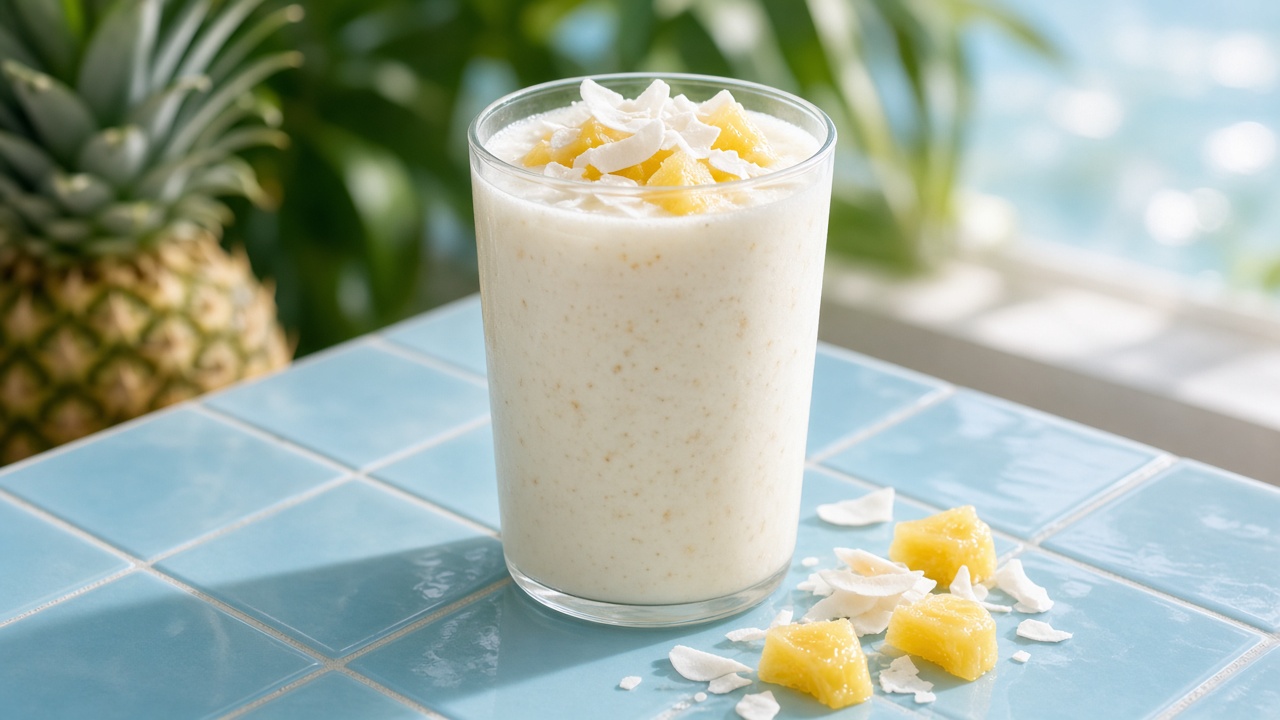
Pineapple Coconut Dream
A cup of pineapple chunks is 165 grams and about 79 milligrams of vitamin C. Coconut milk is where the fat is. Chia is optional thickness.
Ingredients on the card
- 1 cup Frozen pineapple
- 3/4 cup Light coconut milk
- 1/2 Banana
- 1 tsp Chia seeds
Blend order
- Add coconut milk, then fruit and chia.
- Blend until the pineapple is fully crushed.
- Rest 1 minute if you want the chia to thicken the drink slightly.
Pineapple Coconut Dream reads like a dessert name. The ingredients are simpler than the name: frozen pineapple, light coconut milk, half a banana, and a teaspoon of chia. Split the nutrition the same way. Pineapple brings vitamin C and carbohydrate. Coconut milk brings fat, and "light" means you must read a carton. Banana brings more carbohydrate. Chia brings fiber if the teaspoon is actually a weighed amount and not a shake from the jar.
Pineapple chunks
FDC 169124, raw pineapple, all varieties, lists 1 cup of chunks at 165 grams. Per 100 grams: 50 kilocalories, 0.54 grams of protein, 13.12 grams of carbohydrate, 1.4 grams of fiber, 9.85 grams of sugars, and 47.8 milligrams of vitamin C. The cup is about 83 kilocalories, 1 gram of protein, 22 grams of carbohydrate, 2.3 grams of fiber, 16 grams of sugars, and 79 milligrams of vitamin C.
Seventy-nine milligrams sits on top of the NIH vitamin C amount for adult women (75 milligrams) and just under the amount for adult men (90 milligrams). Canned pineapple in syrup is not this row. If you use canned fruit, the syrup's sugars are additional, and you should log the can. Frozen unsweetened chunks are the closest home match to the raw entry. Rinse a whole pineapple's rind under running water before you cut it, and scrub the rind with a clean brush. The FDA groups melons and other firm produce together for that scrub. A pineapple rind is firm enough to deserve the same courtesy. Soap stays off the fruit.
Vitamin C declines with long storage and with cooking, per the NIH fact sheet. A smoothie is uncooked. A pineapple that fermented in the fruit bowl is not a vitamin strategy. Smell it. Discard it if it is sharp in the wrong way.
Banana, the half
Half of the USDA large banana (136 grams, FDC 173944) is 68 grams if you split it evenly. The large fruit is about 121 kilocalories and 31 grams of carbohydrate, so the half is about 60 kilocalories and 16 grams of carbohydrate, with about 1.8 grams of fiber and about 243 milligrams of potassium. If you eat the other half separately, it counts in the day, not in the glass. The recipe says 1/2 banana. Weigh it once. A huge banana's "half" can be the size of someone else's whole fruit.
Chia, the teaspoon
The recipe says 1 teaspoon. FDC 170554 gives an ounce, 28.35 grams, not a teaspoon. Per 100 grams, fiber is 34.4 grams and energy is 486 kilocalories. A 5-gram teaspoon, if that is what your spoon holds, is about 1.7 grams of fiber and 24 kilocalories. A 12-gram spoon is about 4 grams of fiber and 58 kilocalories. Those two "teaspoons" are not the same food. Weigh one and keep using that spoon. People who bloat when fiber jumps should not start with a heaping spoon on top of a day that already included beans. NIDDK connects large fiber jumps with gas symptoms. The fiber article's ramp starts much smaller than an ounce.
Coconut milk, light versus the database
FDC 170173 is canned coconut milk at 197 kilocalories and 21.33 grams of fat per 100 grams, with a cup at 226 grams. The recipe asks for 3/4 cup light coconut milk. Three-quarters of the rich cup is about 170 grams and, if it were the rich product, about 335 kilocalories and 36 grams of fat. Light coconut milk should be lower. The only accurate number is the one printed on the carton you opened. Copy serving size, calories, and fat into the note where you keep this recipe. Using the rich USDA row for a light carton will make you think the drink is heavier than it is, or, if you log the light carton against a full-fat can, you will undercount that can.
A documented rich-milk option, if you want one you can calculate without a carton: 60 grams of FDC 170173 is about 118 kilocalories and 13 grams of fat, plus 1.2 grams of protein (2.02 grams per 100 grams). That is closer to a generous splash than to 3/4 cup. It is a valid drink. It is not identical to the recipe card.
One fully cited combination
Using 165 grams pineapple, 68 grams banana, 5 grams chia (assumed and labeled as assumed), and 60 grams of canned coconut milk from FDC 170173:
- Calories: about 83 + 60 + 24 + 118 = 285
- Carbohydrate: about 22 + 16 + 2 + 1.7 = 42 grams
- Fiber: about 2.3 + 1.8 + 1.7 + 0 = 6 grams (canned coconut milk's fiber was not in the fields retrieved for FDC 170173, so it is left at zero rather than guessed)
- Fat: about 13 grams from the coconut milk, plus under 1 gram from the fruit
- Vitamin C: about 79 milligrams from pineapple, plus a little from banana (8.7 milligrams per 100 grams, so about 6 milligrams in 68 grams)
- Protein: about 1 + 0.7 + 0.8 + 1.2 = roughly 4 grams
Forty-two grams of carbohydrate is about 15% of the 275-gram Daily Value. Four grams of protein is not a meal's protein. Fat depends almost entirely on how much coconut milk you poured. Change the coconut milk line and you change the drink's character more than changing the chia from 5 grams to 8 grams.
If your light carton says a 3/4 cup serving is, for example, far below 118 kilocalories, your drink is lighter than this cited combination. Keep the carton's number. Discard mine for that ingredient only.
Blend order for stringy pineapple
Coconut milk and banana first, then pineapple, then chia. Pineapple core is fibrous. If you left the core in, blend longer. The strings are texture, not a safety problem, unless the fruit itself was spoiled. Let chia sit one minute if you want a slightly thicker sip. Leave it out if you are in week one of a fiber ramp.
Frozen pineapple can stall a small blender. Add liquid before you decide the motor is weak. A splash of water is zero calories. A splash of extra coconut milk is not.
Food handling
Cut pineapple is perishable. Refrigerate it at 40°F. Freeze extra chunks in a flat bag marked 165 grams if you want morning speed. Hold the freezer at 0°F. Drink the blended result the same day. Do not store a finished coconut smoothie on the counter. The fat will not preserve it.
Skip or edit if
You need more protein (this glass does not have it). You are limiting carbohydrate tightly (42 grams in the cited version is a lot of a small cap). You have a seed restriction and have not asked about chia. You only have sweetened cream of coconut, which is a dessert ingredient with a different sugar load than FDC 170173. You are feeding a toddler and the portion should be a few sips, not the full adult cup.
Sources for Pineapple Coconut Dream
- USDA FoodData Central FDC 169124 (pineapple, cup of chunks 165 grams), FDC 173944 (banana), FDC 170554 (chia), FDC 170173 (canned coconut milk).
- NIH vitamin C consumer fact sheet, adult amounts and the note on storage and cooking.
- U.S. FDA Daily Values for total carbohydrate and protein.
- NIDDK gas page, on fiber jumps.
- U.S. FDA produce page and FoodSafety.gov temperatures.