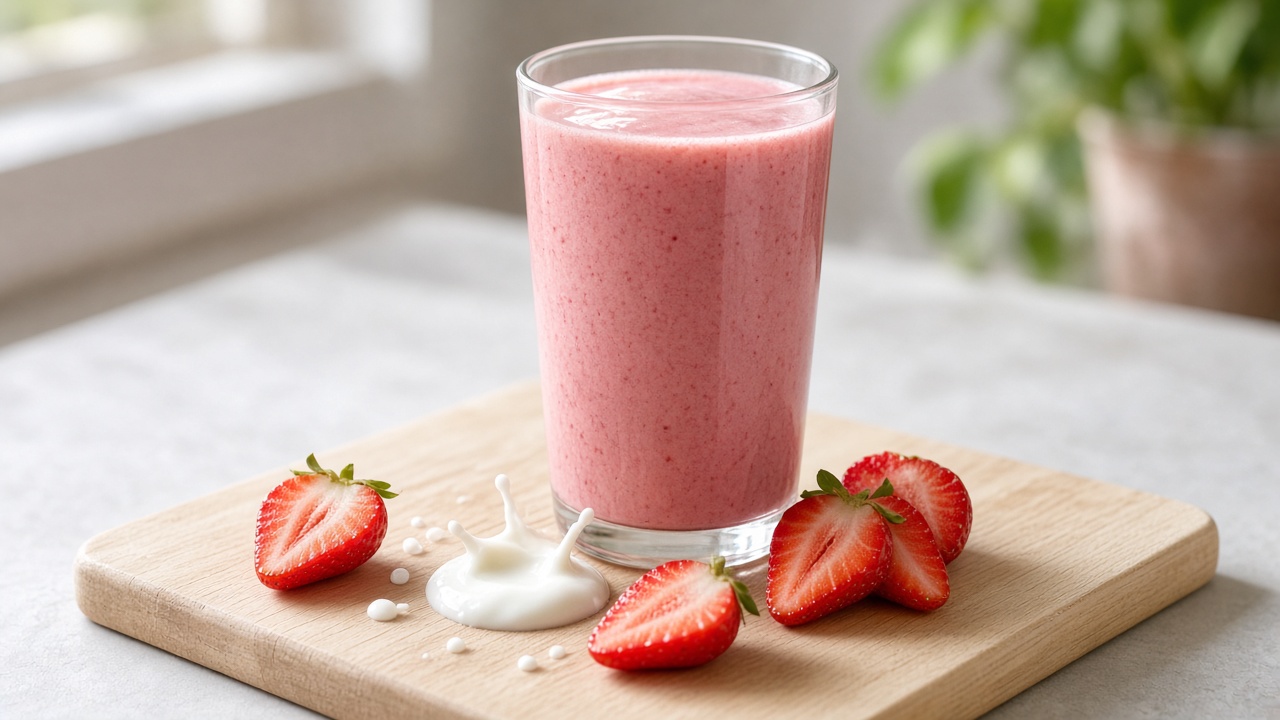
Strawberry Sunshine
A cup of sliced strawberries carries nearly 100 milligrams of vitamin C. The Greek yogurt is where the protein is.
Ingredients on the card
- 1 cup Strawberries, hulled
- 1/2 cup Plain Greek yogurt
- 1/2 cup Milk of choice
- 1 tsp Honey (optional)
Blend order
- Add milk and yogurt to the blender.
- Add strawberries and honey if using.
- Blend until creamy and pink.
- Serve cold.
Strawberry Sunshine is strawberries, plain Greek yogurt, milk, and an optional teaspoon of honey. The berries are doing vitamin C work. The yogurt is doing protein work. Honey is optional sugar. Milk ties the texture together and adds a smaller second protein line. Keep those as four different decisions, because they are.
Strawberries, sliced, one cup
FDC 167762 lists 1 cup of sliced strawberries at 166 grams. Per 100 grams: 32 kilocalories, 0.67 grams of protein, 7.68 grams of carbohydrate, 2.0 grams of fiber, 4.89 grams of sugars, 58.8 milligrams of vitamin C, 24 micrograms of folate, 153 milligrams of potassium, and 2.2 micrograms of vitamin K.
The cup: about 53 kilocalories, 1 gram of protein, 13 grams of carbohydrate, 3.3 grams of fiber, 8 grams of sugars, 98 milligrams of vitamin C, 40 micrograms of folate, and 254 milligrams of potassium. Vitamin K is negligible next to spinach.
Ninety-eight milligrams of vitamin C is above the NIH amount for adult men (90 milligrams) and clearly above the amount for adult women (75 milligrams). The fact sheet says fruits and vegetables are the main sources, and it names strawberries among them. It also says vitamin C in food drops with long storage and with cooking. Blend berries that still smell like berries. A gray, weeping box is not the 98 milligram cup even if it weighs 166 grams. This page will not invent a decay curve. It will tell you to buy fruit you would eat plain.
Smokers are listed at an extra 35 milligrams a day on that fact sheet. A strawberry cup still covers a nonsmoker's amount and does not replace a conversation about smoking. The upper limit for adults is 2,000 milligrams a day from all sources. Food at this scale is not close to that limit. Powders can be.
Rinse strawberries under running water, lift the green tops after, and skip soap. The FDA is plain about soap on produce. Keep them at 40°F or below. They are on the FDA's list of perishable fruits that belong in the refrigerator.
Yogurt, the protein
FDC 330137, plain nonfat Greek yogurt, is 10.3 grams of protein, 61 kilocalories, and 3.64 grams of carbohydrate per 100 grams. A 170-gram portion is about 17.5 grams of protein, 104 kilocalories, and 6.2 grams of carbohydrate. The recipe card says 1/2 cup. A half cup is not the same phrase as 170 grams. Weigh what you scoop. If the scale says 120 grams, protein is about 12.4 grams (10.3 times 1.20), not 17.5. The difference is a heaped versus a level scoop, and it is large enough to matter if you are counting.
Flavored yogurt can look like this recipe and carry a very different added-sugar line. Use plain. Sweeten with the fruit, or with a measured honey spoon you chose on purpose.
Seventeen grams of protein is about 35% of the FDA 50-gram protein Daily Value. The FDA calls 20% or more high. This yogurt portion qualifies. The strawberries do not. People who want "strawberry protein" from berries alone are looking at about 1 gram.
NIDDK lists yogurt among dairy foods that give some people more gas. If that is you, the vitamin C is still available from the berries blended with a milk you tolerate, or with water, at a lower protein number. Log which version you used.
Milk
The recipe says 1/2 cup of milk. For 2% milk, FDC 171267, a full cup is 244 grams, so half is 122 grams: about 61 kilocalories, 4 grams of protein, 5.9 grams of carbohydrate, and 146 milligrams of calcium. Whole milk will be higher in fat and calories at the same volume. The whole-milk entry FDC 746782 is 60 kilocalories and 3.2 grams of fat per 100 grams, so 122 grams is about 73 kilocalories and 4 grams of fat, with protein still near 4 grams (3.27 per 100 grams).
Pick one and write it down. "Milk of choice" is how calorie logs drift.
Honey, if you use it
The recipe allows 1 teaspoon, not a USDA tablespoon. FDC 169640 lists a tablespoon at 21 grams: about 64 kilocalories and 17 grams of sugars (honey is 304 kilocalories and 82.12 grams of sugars per 100 grams). A teaspoon is commonly taken as a third of a tablespoon, but this page will not certify 7 grams unless you weigh it. Put the spoon on the scale. Seven grams of this honey is about 21 kilocalories and about 6 grams of sugars. Twenty-one grams is the full tablespoon, easy to pour if the honey is warm.
Those sugars are added sugars. The FDA Daily Value is 50 grams a day. The strawberries' own sugars are not "added," and they still count in total carbohydrate. You can skip honey. Ripe berries plus yogurt are already sharp and sweet. Taste before you pour.
A fully weighed example
Assumption, labeled as an assumption: 166 grams strawberries, 170 grams plain nonfat Greek yogurt, 122 grams 2% milk, no honey.
- Calories: about 53 + 104 + 61 = 218
- Protein: about 1 + 17.5 + 4 = 22.5 grams
- Carbohydrate: about 13 + 6.2 + 5.9 = 25 grams
- Fiber: about 3.3 grams, almost all from the berries
- Vitamin C: about 98 milligrams from the berries, plus a trace from milk (0.2 milligrams per 100 grams on the 2% entry)
Twenty-two grams of protein is nearly half the 50-gram Daily Value. Twenty-five grams of carbohydrate is under 10% of the 275-gram Daily Value. That balance is why this jar is different from Blueberry Bliss, which carried roughly 62 grams of carbohydrate and about 6 grams of protein in the example on that page. Similar pink color. Different job.
Add 7 grams of honey only if you weighed it, and add about 21 kilocalories and 6 grams of sugars to the total.
Blend and serve cold
Milk and yogurt in first, then berries, then honey if any. The mixture looks thin for ten seconds and then turns opaque. Stop when the seeds are evenly scattered. You do not need a long grind. Drink it cold. Strawberries that warm up taste flatter, which is a kitchen opinion, not a nutrient claim.
If you meal-prep, freeze the berries in a bag marked 166 grams and keep the yogurt in the refrigerator. Add dairy in the morning. A frozen yogurt brick blended three days later is a texture gamble this recipe does not need. Same-day for the finished drink.
People who should change the jar
Milk and yogurt are both dairy. Lactose intolerance, a milk allergy, and a prescribed low-iodine diet are three different reasons to pause. The NIH iodine fact sheet places milk and yogurt on the iodine-containing side of a low-iodine diet used before certain procedures. If you were handed that diet, this recipe is off the list until the restriction lifts. Fruit alone can stay, if your handout allows fruit.
A milk allergy is not lactose intolerance. Do not "try a splash" to test an allergy. Use a dairy-free recipe instead.
Vitamin K is low here. Warfarin planning is about the green recipes, not this one, unless your overall diet changed in other ways the same week.
Sources for Strawberry Sunshine
- USDA FoodData Central FDC 167762 (strawberries, cup sliced 166 grams), FDC 330137 (plain nonfat Greek yogurt), FDC 171267 (2% milk, cup 244 grams), FDC 746782 (whole milk), FDC 169640 (honey, tablespoon 21 grams).
- NIH Office of Dietary Supplements, Vitamin C consumer fact sheet, including the strawberry mention, adult amounts, storage and cooking, the extra 35 milligrams for people who smoke, and the adult upper limit.
- U.S. FDA Daily Values for protein, total carbohydrate, added sugars, and calcium.
- NIDDK, gas and dairy foods.
- NIH iodine consumer fact sheet, low-iodine diet foods.
- U.S. FDA, "Selecting and Serving Produce Safely."