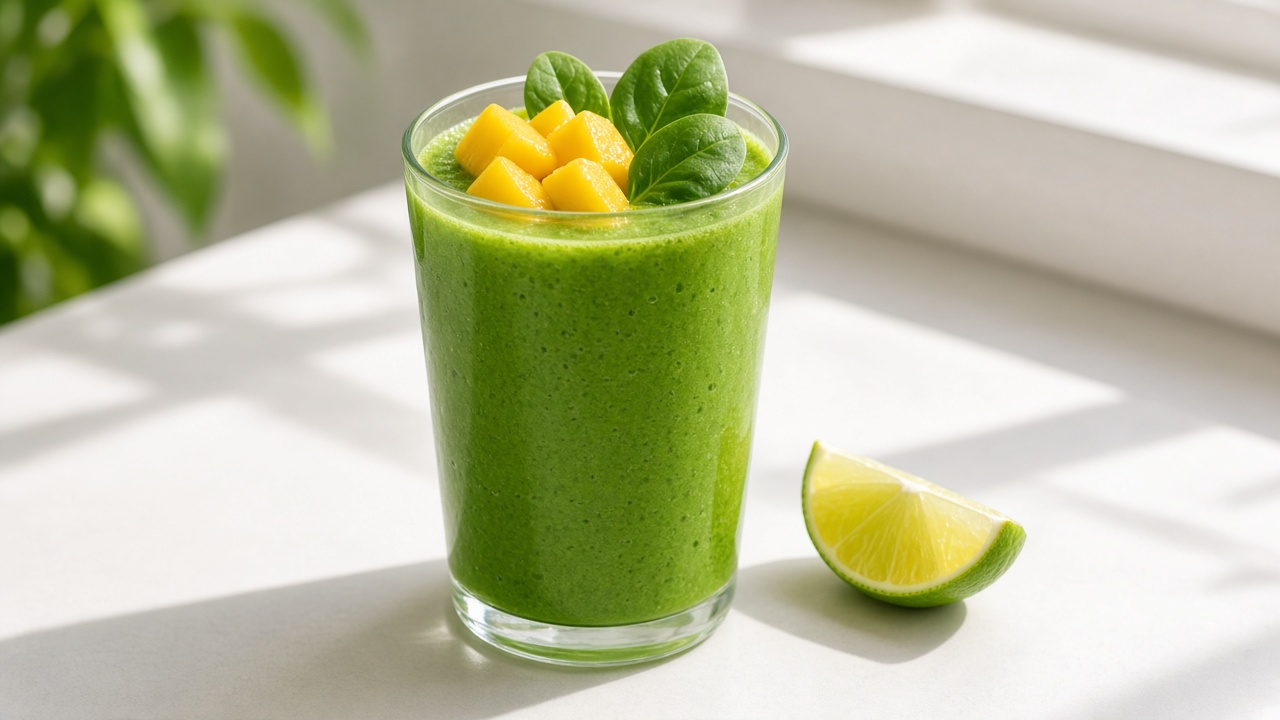
Tropical Green Glow
One cup of spinach is 30 grams. One cup of mango pieces is 165 grams. The fruit, not the leaf, sets the calories.
Ingredients on the card
- 1 packed cup Baby spinach
- 1 cup Frozen mango chunks
- 1 cup Coconut water
- 1 tsp Lime juice
Blend order
- Pour coconut water into the blender.
- Add spinach, then mango and lime juice.
- Blend until the spinach disappears into the fruit.
- Taste and add a splash more coconut water if it is too thick.
Tropical Green Glow is spinach, frozen mango, coconut water, and lime. The green color is the spinach. The calories, the carbohydrate, and most of the vitamin C are the mango. Coconut water is a light, slightly sweet liquid with some potassium. Lime is a bright teaspoon, not a second fruit. Once those roles are clear, the drink is easy to adjust without wrecking it.
Spinach, the 30-gram cup
FDC 168462 lists 1 cup of raw spinach at 30 grams: about 7 kilocalories, 0.7 grams of fiber, 30 milligrams of calcium, 0.8 milligrams of iron, 167 milligrams of potassium, 8 milligrams of vitamin C, 145 micrograms of vitamin K, and 58 micrograms of folate. The per-100-gram row is 23 kilocalories, 2.2 grams of fiber, 99 milligrams of calcium, 2.71 milligrams of iron, 558 milligrams of potassium, 28.1 milligrams of vitamin C, 482.9 micrograms of vitamin K, and 194 micrograms of folate.
Vitamin K is the headline. About 145 micrograms in the cup is above the FDA Daily Value of 120 micrograms. Anyone taking warfarin needs a steady vitamin K intake from day to day. The NIH vitamin K fact sheet says a sudden increase can be tied to clotting and a sudden drop to bleeding, for people on that medicine. If this glass becomes a daily habit, it is a high-vitamin-K habit. Tell the prescriber. If you do not take warfarin, the same cup is an ordinary serving of a leafy vegetable the NIH lists as a vitamin K food.
Iron in the cup is under 1 milligram, against an 18-milligram Daily Value. The leaf is not the iron story people repeat. Folate at about 58 micrograms sits against a 400 microgram DFE Daily Value. Real, and not a whole day.
Mango, the 165-gram cup
FDC 169910 lists 1 cup of mango pieces at 165 grams. Per 100 grams: 60 kilocalories, 0.82 grams of protein, 14.98 grams of carbohydrate, 1.6 grams of fiber, 13.66 grams of sugars, 36.4 milligrams of vitamin C, 43 micrograms of folate, and 168 milligrams of potassium.
The cup: about 99 kilocalories, 1.4 grams of protein, 25 grams of carbohydrate, 2.6 grams of fiber, 23 grams of sugars, 60 milligrams of vitamin C, 71 micrograms of folate, and 277 milligrams of potassium.
Sixty milligrams of vitamin C is most of the 75 milligram NIH amount for adult women and two-thirds of the 90 milligram amount for adult men. The NIH fact sheet says prolonged storage and cooking can lower vitamin C in food. Frozen mango that you blend raw still counts as uncooked. It may have sat in a freezer bag for months. Quality fades. This page does not have a tested vitamin C loss for your bag, so the 60 milligram figure stays a raw-fruit planning number.
Coconut water
FDC 174831, unsweetened ready-to-drink coconut water, lists a cup at 245 grams. Per 100 grams: 18 kilocalories, 0.22 grams of protein, 4.24 grams of carbohydrate, 3.92 grams of sugars, 165 milligrams of potassium, and 9.9 milligrams of vitamin C. The cup is about 44 kilocalories, 10 grams of carbohydrate, 10 grams of sugars, 404 milligrams of potassium, and 24 milligrams of vitamin C.
The recipe says 1 cup. Use 245 grams if you are matching this entry. A splash more or less changes potassium and sugars in a straight line. Brands with added sugar are not this row. "Original" coconut water sometimes includes added sugar even when the front of the carton looks plain. Read the added-sugars line. The FDA Daily Value for added sugars is 50 grams. The sugars in unsweetened coconut water and in mango are still carbohydrate. Added sugars are the extra the label isolates.
Potassium from the coconut-water cup (about 404 milligrams) plus mango (about 277) plus spinach (about 167) is roughly 850 milligrams, about 18% of the 4,700 milligram Daily Value, before lime. People on potassium restrictions should not casually stack this glass. Ask, with these numbers in hand.
Lime
The recipe calls for 1 teaspoon of lime juice. This page did not pull a lime-juice FoodData Central entry in the batch used for lemon. Do not borrow the lemon numbers and call them lime. A teaspoon of citrus juice is a flavor amount, on the order of 5 grams, and it will not move calories the way mango does. If you need a documented citrus figure, the lemon-juice entry used elsewhere (FDC 167747) is 22 kilocalories and 38.7 milligrams of vitamin C per 100 grams, so 15 grams of lemon juice is about 6 milligrams of vitamin C. Lime will be in that neighborhood and is not identical. Taste with lime. Log lemon only if you actually used lemon.
Putting the documented pieces together
Spinach cup + mango cup + coconut-water cup, ignoring the teaspoon of lime:
- Calories: about 7 + 99 + 44 = 150
- Carbohydrate: about 1.1 + 25 + 10 = 36 grams
- Fiber: about 0.7 + 2.6 + 0 = 3.3 grams
- Vitamin C: about 8 + 60 + 24 = 92 milligrams
- Vitamin K: about 145 micrograms, almost all from spinach
- Potassium: about 850 milligrams
One hundred fifty kilocalories and 36 grams of carbohydrate. Fiber is low next to the 28-gram Daily Value. Anyone expecting a "green drink" to be a high-fiber meal will be disappointed, correctly. Add oats or chia only if you want those grams, and count them. The recipe as written does not include them.
Vitamin C near 92 milligrams meets or passes the NIH adult amounts in this one glass, using raw-food tables. That is composition, not a claim about colds. The NIH fact sheet says vitamin C supplements do not keep most people from catching a cold. Food vitamin C is still a nutrient with a daily amount. This drink can cover a large share of that amount. It does not need a second story.
Blending so the leaf disappears
Coconut water and spinach first, until the flecks are small, then mango. Frozen mango thickens the pour. If the jar looks like a pudding, add coconut water 30 grams at a time (about 5 kilocalories and 1.3 grams of carbohydrate). Lime at the end, so you can taste it.
Wash the spinach under running water. If the mango is whole, wash the peel before cutting. No soap. Refrigerate cut mango. Freeze extra portions flat, at 0°F, if you are packing ahead. FoodSafety.gov says food held continuously at 0°F or below can be kept indefinitely for safety, with quality as the thing that declines.
When this is the wrong green drink
Warfarin users who do not already eat this much spinach should talk to the prescriber before it becomes breakfast. People limiting potassium or carbohydrate can see the totals above and decide. Children get a smaller pour of the same drink, not a lecture about Daily Values. If you wanted a higher-protein breakfast, this glass has almost none (mango and coconut water and spinach together are only a couple of grams). Pair it with eggs or yogurt on the side, or pick a different recipe.
Sources for Tropical Green Glow
- USDA FoodData Central FDC 168462 (spinach, cup 30 grams), FDC 169910 (mango, cup pieces 165 grams), FDC 174831 (unsweetened coconut water, cup 245 grams).
- NIH Office of Dietary Supplements vitamin K fact sheet (warfarin, adult amounts) and vitamin C fact sheet (adult amounts, storage, and the cold summary).
- U.S. FDA Daily Values: vitamin K 120 mcg, iron 18 mg, folate 400 mcg DFE, potassium 4,700 mg, added sugars 50 g, fiber 28 g.
- U.S. FDA produce-handling page and FoodSafety.gov freezer note.